
On trusting AI decisions without understanding them
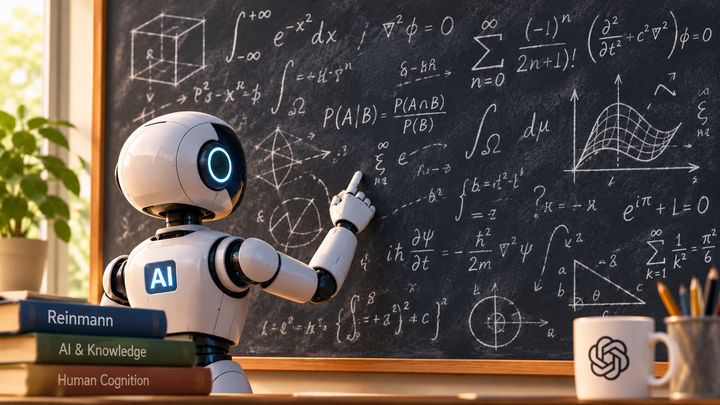
AI may have proved theorems that have haunted mathematicians for the last 100 years.
We are seeing AIs prove hard theorems: ChatGPT with Navier-Stokes, Claude with Riemann. But the proofs are lengthy, probably inelegant, and not easy to understand, even for experts in the field. This is stuff that takes years to fully grasp. Some mathematicians have been working on these problems forever and made only small advances. Now we see AIs tackling hard problems with ease.
The inspiration for this article comes from Raffaele Gaito's video "Do you trust an AI that you cannot understand?" (it's in Italian, but with YouTube's translation feature you can surely enjoy it). Gaito's video discusses the two types of reactions that this kind of announcement generates.
- One type of reaction is confusion: if AI is doing all this work, are we humans still needed? What is our purpose here?
- The other reaction is rejection: if I can't understand it, I can't trust it.
In the next few years, AI will fix everything. Will we let it?
Regarding the first reaction, confusion, I recently read another interesting article, "Handing over humanity". In the very near future we may live in some kind of utopia where everything just works: an AI will decide how much you have to pay in taxes, and those taxes will be used exactly the way you think they should be, or even better: to fund and organize schools, fix potholes, pay doctors, run public transportation and garbage collection, and deal with the climate crisis, war spending, immigration, and who knows what else. We'll reach a point where there's no need for politics and no need to argue because, from every point of view, the AI is right. Is humanity designed for something like that? The author says no: we humans love our freedom and our self-determination, which means we want to be the source of our own happiness and, of course, our own problems. So, once we reach superintelligence, what will happen to humanity? Do we still have a place? Personally, I'll be the one building barricades against the machines.
How we judge good vs. bad
Now, let's tackle the second reaction: rejection. This is probably the reaction I understand best. I understand it because, in every aspect of my life, I trust things whose workings I understand. Of course, I can't explain every possible detail. If you ask yourself "why" enough times, you may end up with a postdoc in quantum physics, and of course we're not all PhDs here. At some point we stop asking why and trust the answers. Sorry, not the answers: the people giving those answers. We humans can tell right away who is able to answer every possible question and who isn't. Historically, we trust the people who can explain themselves more, the ones who know their shit. I hire these kinds of people. I drink beer with these kinds of people. I also drink beer with people who say "I don't know" when they're not competent.
So, do I trust the person who put the prompt into Claude to get the hypothesis proved? No. THIS GUY must show me that he has understood the proof. THIS GUY should spend his energy convincing the world of how the proof works, and that it's correct. He should have an answer for every objection. And he has to do this not with me, but with his peers. I really don't care that Claude says so; I care that the people who are familiar with the problem understand it and agree that it's solved.
Looking at it from another angle: right now, the best way to use AI is to understand new things. I do this all the time. Sometimes I get really angry when AI fails to explain something. I once asked what quantum computing is, and the answer was disappointing. I had to ask multiple follow-up questions to get something that barely clicked. How can I trust something I didn't understand?